Refining Gold From Circuit Boards and Electronic Scrap with Muriatic & MX3
Introduction
The acid used in this process is muriatic (also known as hydrochloric) acid. This acid is corrosive (see warning label on your bottle). For this reason, this kind of refining is best done outdoors, away from anything that may be damaged by exposure to these fumes.
Having described it's hazards, it must be pointed out that, like most industrial processes, refining gold in acid is quite safe when performed under controlled conditions. In addition, the results of doing your own refining can be quite sweet. Based upon feedback we've gotten from several hundred users, we estimate that the return of gold, when you refine the material yourself, is 10 times the return when sent in to a commercial refining company.
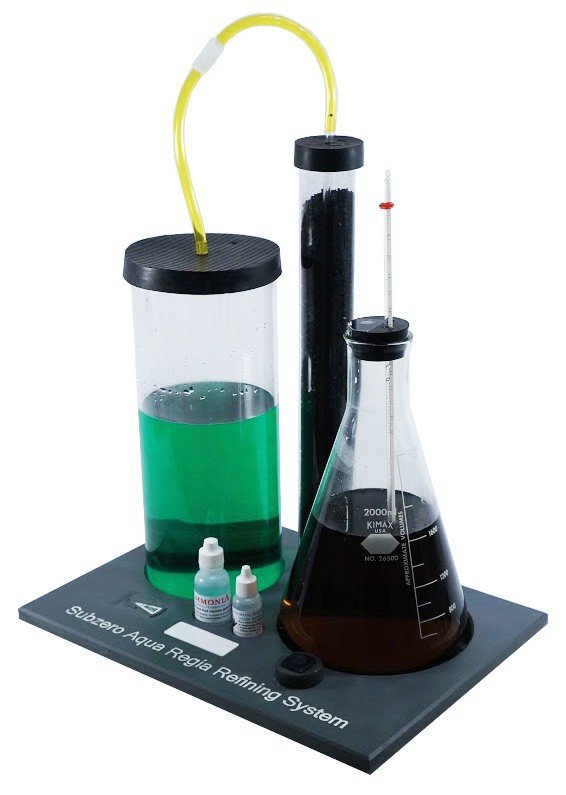
To refine gold with the Aqua Regia scrubber unit, you will need the following additional items:
- Protective clothing (minimum requirement: goggles and rubber gloves)
- Muriatic (also called hydrochloric acid 15%-30% strength)
- Sodium bicarbonate (baking soda) to neutralize the acid when finished
- Tap water and distilled water for rinsing the pure gold
- Containers for the boards (most people use 5 gallon plastic buckets)
Before refining
Cut off those portions of the board that have gold. Discard the rest. Chips, which have gold inside as well as outside, must be broken open. On a small scale, one tap with a hammer should suffice. With lots of chips, you might want to use a cement mixer.
In a glass or plastic container (a 5 gallon, clean white bucket will work well), add 1 lb MX3 to half a gallon of muriatic or hydrochloric acid. Do not use a metal container. Not all the MX3 will dissolve. This is normal. Do not discard the undissolved MX3. The undissolved MX3 is required to be in the solution for the gold to complete its dissolution.
Dissolving the gold
The acid should be at room temperature. Place your boards in a plastic mesh, or plastic wire basket or a plastic mesh bag. The acid has to pass through the basket or bag, so make sure it is either plastic mesh or plastic wire.
Add the basket or bag, with your boards, to the acid solution. The metal will begin to fizz and give off an invisible or slightly brown fume. You can cover the container, but do not seal it tightly because you don't want a built up of gas pressure. You can speed up the process by heating your solution, but this creates added hazard- hot acid fumes more rapidly and is more corrosive. At room temperature, dissolving time is usually between half an hour to two hours. Check the boards to make sure all the gold has been removed and dissolved into the aqua regia acid.
Remove the basket from the acid, taking care not to drip acid anywhere. The aqua regia is not used up yet, so you can use the same acid to dissolve the gold off more boards. You can continue to use this acid, several times, to dissolve the metal off additional boards until it is no longer effective. The acidy boards should be rinsed (with water) in another bucket. Any brown particles are likely to be gold and should be recovered and put into a future refining bath. If you believe that some solid bits have fallen into the solution during dissolving, then (after the acid is no longer effective in dissolving any more metal), you should pour the solution into a different bucket, leaving the solids behind. Any solids left in the solution will contaminate the pure gold you are about to precipitate.
Adjusting the pH and precipitating the pure gold
When the aqua regia is no longer effective (no longer dissolves the gold on the boards), it is time to recover the pure gold from the solution.
The acid will be a dark, emerald green color and should be clear, like Coca Cola, not murky or muddy looking (nothing floating inside the dark waters). If the acid is murky, it may contain particles and should be decanted into another 5 gallon bucket or it should be filtered.
Now add a pinch of urea to the dark acid solution. If it fizzes, add additional urea until it no longer fizzes. When there is no longer any fizzing, it is time to precipitate your pure gold.
Measure out all the precipitant that you need (add 2 tablespoons (or one ounce) of Quadratic for every ounce of dissolved metal (dissolved metal content, not just dissolved gold content). Heat the solution to at least 160F. Do not use a metal container. In about an hour, all the gold should have precipitated to the bottom of your container. The gold precipitate will be a golden brown color and the particles will be large and quite heavy. Heavy particles are important. All alternative precipitants result in fine, light particles that are tiny and tend to float. Filtering or decanting is quite problematic and gold is inevitably lost when using any other precipitant..
Once precipitation is complete, test the acid for the presence of dissolved gold with Precious Metal Detection Liquid.
Testing to make sure no dissolved gold is discarded
Precious metal detection liquid will detect the presence of dissolved gold, down to 4 parts of gold per million parts of acid, detecting the presence of about 1/1,000th of 1 gram of dissolved gold. Testing for the presence of dissolved gold is absolutely necessary to ensure that no dissolved gold is thrown away with the waste acid.
To test, first immerse the end of the stirring rod in the acid. Remove it and touch that end to a paper towel to make a wet spot. Put a drop of gold detection liquid on the wet spot on the paper towel. If any gold is still dissolved in the acid, the wet spot will turn a purple-black or a purple-brown. If you see this color change then give the precipitant more time to work and/or add more precipitant.
Rinsing the pure gold
TThe acid should now be a clear, amber or a green color with a golden brown mud at the bottom. Pour off the acid into another, non-metal container. Do not pour off any of the golden brown mud. The mud is pure gold.
When all the acid is poured off, rinse with a gallon of household ammonia. After rinsing, add 2-3 gallons of tap water to the mud. Be sure to pour off all of the acid before adding water. Stir the water and then let the mud settle. Pour off the water into the container with the acid. Remember, do not to pour off any particles of golden brown mud with the water. Repeat this rinsing 2-3 more times and then test the purity.
Testing to ensure purity
Test with aqua ammonia to ensure high purity of your gold. Tilt your bucket so that the small amount of water retained in the gold mud runs off and form a very small puddle in the corner of your bucket. Place a drop of aqua ammonia test liquid in the puddle. If you see any change in color to blue, even a very pale blue, rinse and test again.
Give the mud a last rinse, this time with distilled water.
Drying and melting
Rinse the mud into a beaker that is made to be heated or into glass coffee pot. Put the beaker or pot on a hot plate to dry the mud. Do not preheat the hot plate or thermal shock may cause the beaker to break.
Melt the dried mud (now a powder). If using a torch, first wrap the powder in tissue paper and then soak that in alcohol. Also, use a Burno crucible. This will keep your gold from being blown away by the gas pressure from the torch. The gold will again take on the appearance of metal. If you've followed the instructions carefully, the gold will be 99.95 % pure with virtually no losses.
Platinum
Computer Scrap - Very few boards have platinum. Typically, platinum (and other platinum group metals, like palladium) are found on the surface of the hard drive platter (the inside is aluminum). To dissolve the aluminum, first make cut marks across the disks and then put in a saturated solution of cold water and lye. Lye is very corrosive, so wear protective gear. As the solution comes in contact with the aluminum, the solution will become very hot and the aluminum will dissolve. Discard the solution and recover and rinse the platinum. The platinum will not be pure. To make pure and to separate one platinum metal from another, you will need the Simplicity Refining System.
Catalytic Converters - Follow the normal procedure for refining gold, but heat the aqua regia to simmering. Remove and replace the catalytic converters after the platinum is dissolved off the surface. Precipitate the platinum from solution with zinc powder or aluminum foil. The precipitated metal will not be pure and requires the use of the Simplicity Refining System for further purification.
© 2026 Shor International Corporation & The I. Shor Company. All rights reserved.