Forming a Niche
Electroforming frees designers from weighty constraints and offers a myriad of possibilities. But marketing the final product takes attention to detail and an informed customer.
The following article by Clark Heideger is reprinted from AJM magazine
Electroforming: is it a technological marvel or a jewelry flash-in-the-pan?
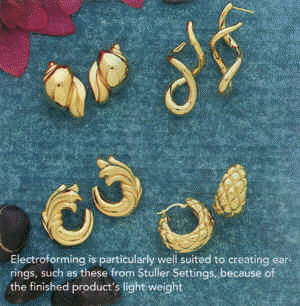 In many ways this blend of new technology and traditional electroplating techniques represents the cutting-edge in jewelry manufacturing. Electroforming allows manufacturers to produce uniquely designed lightweight jewelry that is impossible to create by casting or stamping. And the results are often quite remarkable.
But how about marketable? Sure, the process by which an electroformed piece of jewelry is created may seem "way cool" to a handful of computer nerds. In fact, one of the world's premier nerds, Prince Charles of Great Britain, was crowned with an electroformed crown. But outside the nerd niche, technology doesn't score many points when it comes time to making a jewelry buying decision.
"The retailers don't care about the technology," says Brian Fleming of Carla Corp., a Providence-based jewelry manufacturer that helped pioneer electroform jewelry in this country. "They want to see the look, the styling. They want to touch it, feel it, put it on their ears.
Upscale retailer Judith Fineblit of Bijoux Extraordinaire agrees. When Judith makes a sales presentation in her Manchester, NH, store, the term "electroform" is rarely used. "If someone asks why it's so expensive, I explain the technology," says Fineblit. "But whenever I'm selling the pieces, I don't say, 'By the way, that's an electroform.' The problem is the name confuses people. They mix it up with electroplating."
In order for us to avoid confusion with its more common electroplating cousin, let's take a closer look at electroforming technology.
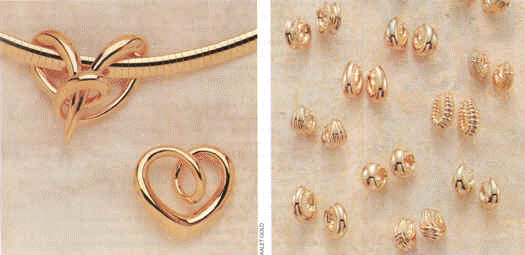 Electroforming permits the creation of jewelry designs with flowing undercuts and shapes impossible to achieve with stamping. These examples are from Skalet Gold's 18k Papillon artform collection (top led*), Carla Corp's CaSandra Collection (top right and bottom left) and from Enthone OMI, utilizing the company's Artform Excell process.
When laymen talk about electroforming, they like to use the analogy of an M & M candy: if you sucked out the chocolate so that all you were left with was the shell, and that shell were gold, you'd have an electroform.
 That's a nice simple analogy for a retailer to use when chatting with a customer. But since you are not average consumers, let's get a little more technical.
Imagine if you took a typical three-dimensional piece of costume jewelry, gave it a gold electroplate, and then were somehow able to remove the base-metal core. You'd be left with a very thin gold foil shell shaped like the original piece.
Or at least, that's what you'd have if you could somehow suspend the piece in a vacuum. In reality, the gold electroplate surface is only a few microns thick and it tends to crumple up after you remove the core. A gold surface that thin has no structural integrity: it needs the core to hold its shape.
But what if you were to apply a very dense and thick gold plate? Say 100 to 160 microns, or about four to six thousandths of an inch. Now, when you removed the core, you'd have an electroform, a hollow but sturdy piece of gold in the shape of the original core.
This is precisely what electroforming technology allows you to do. And while this process has been around since the 1840's, it's only been in the last few decades that jewelry manufacturers have begun to explore ways of exploiting the technology.
While there are a variety of electroforming systems on the market that each use slightly different methods, the general principles of the process are the same.
The procedure begins in a manner similar to casting, with the construction of cores or "mandrill." For a typical "hot-bath" electroforming system, these cores are constructed out of a tin-lead bismuth alloy. (There are also "cold bath" systems that utilize wax mandrill.) The cores are constructed by means of familiar white metal spin casting technology: the alloy is injected into a ring mold, and the mandrill are then removed, de-gated and finished.
The quality of this finish is crucial, since any defects on the original mold will be amplified during the gold deposition process. Completed electroforms contain so little workable metal that they cannot be "cleaned up" at a later stage of the electroforming process.
After the mandrils are completed, they are mounted on a rack. This is done either by affixing them with a single screw so that only the screw makes contact with the mandril, or by suspending them from wires, which are anchored into the mandrill during initial casting.
The rack of mandrill then goes through a series of cleaning and plating operations. First, 10 microns of alkaline copper are applied as a barrier to protect the gold from the tin-lead bismuth core. Next, 40 microns of acid copper are added to level and brighten the finish.
The rack is then immersed in a gold bath, where it spends several hours rotating back and forth until it has achieved a preset thickness of about 100 to 160 microns.
Finally, another 10 micron layer of alkaline copper is applied over the gold to protect the outside of the electroform while the core is removed.
When the gold deposition is completed, the core is removed using a process called "evacuation." The mandrill are taken off the rack and the screws or wires are removed, leaving a small hole in each piece that goes through all the plated layers to the core.
The coated mandrill is now heated to a temperature high enough to melt the white metal core without affecting the copper and gold plates. The molten core material escapes through the hole left from fixturing to the rack. Since some of this molten material will invariably splash onto the outside of the piece during evacuation, it's necessary to apply the external alkaline copper barrier
After the core is evacuated, the copper coating is removed by using an acid bath, which etches off the copper without affecting the gold. The empty shell is then heat-treated to relieve stress.
You are left with a hollow gold electroform to which you can affix the necessary findings to transform it mto a charm, earring, bracelet or any other piece.
In the "cold bath" electroforming system that uses wax mandrill, copper barrier plating is not necessary since the wax will not attack the gold. These wax mandrill are made in the same manner as waxes for investment casting (i.e. shot out of a wax pot into molds). In order to make the wax conductive so that the gold will adhere to it, a conductive paint is applied to the mandrill.
Now that we know what electroforming is, let's look at what it isn't.
While electroforming is an efficient process that produces thin-walled jewelry and very little scrap, it is not necessarily a cost-effective alternative to stamping. When you compare the five hours that a piece spends in an electroforming bath to the several seconds it takes a press to bang out a handful stampings, electroforms can't compete on a strictly bottom-line basis.
"Electroforming is not a mass production [technique]," says Massimo Verdi of IECO, an Italian manufacturer of electroforming equipment. "Even with automation, we can only produce a few items with one machine [at a time]."
"If it can be made by stamping, then why not?" agrees equipment dealer David Gold, who acts as the American distributor for IECO. "That's not the idea. The idea is to create designs that flow and cannot be easily stamped."
Questions and Answers
Why do you remove the core?
Believe it or not, this is a common question. Probably because first-time observers are immediately struck by all the time and effort that goes into the evacuation process.
The answer, of course, is that if you don't remove the core you won't be able to market your product as karat gold jewelry. What you will essentially have is a piece of costume jewelry with an incredibly thick and expensive gold electroplated finish.
You will also have a lot of weight. Part of the charm (and marketability) of electroforms is their big gold look combined with light weight. This is what makes the hollow gold process especially suited to earrings.
What do electroform systems cost?
Cost will depend on your needs. Fully automated systems, where you essentially put the mandrill in, tell the computer what you want, and remove your product several hours later, range in price from $300,000 to $500,000. These turn-key systems have the advantage of a short training period and offer consistent results.
Since electroforming is essentially an offshoot of the familiar process of electroplating, it is possible for someone with experience in this area to build their own system. Experts place the equipment cost for the do-it-your-selfer as low as $30,000 to $50,000*. But that's for a system that is not fully automated, and you'll be on your own during the extensive trial-and-error learning process.
*Please note that Shor offers complete small systems for under $1,000.
Can you electroform around gemstones?
There are differing opinions on this one. Obviously stones that are susceptible to damage from the various production processes (heating, acid, etc.) are out of the question. For example, emeralds are traditionally treated with oil, and this treatment would be destroyed during the evacuation process.
But what about other stones, such as diamond and ruby, which have been effectively pre-set in investment castings? Will this work with electroforming? Since these stones are not conductive, you can place them in the mandril, and the gold will form around them. But remember, you cannot make sharp angles, so the process does not lend itself to making shapes like claws. The best you could do would be a flush-mounted stone. Would the final electroform shell have enough strength to hold the stone? Some say yes, some say no. Remember that trial and-error period we talked about earlier?
How do you fill the evacuation hole?
One of the unique considerations when designing for electroforming is to organize the piece in such a way that the evacuation hole will wind up where you want to attach a finding. This allows you to cover up the hole in an unobtrusive way.
An interesting development in Italy is that electroforms are becoming recognized as unique and desirable objects, many manufacturers are leaving the hole in an obvious location. The hole indicates to the wearer (and perhaps, more importantly, to the observer) that the piece is in fact a genuine electroform. Think of it as a kind of designer label.
Will electroforming work with less expensive materials, like silver?
Absolutely. In fact, many designers have been working with electroformed silver for some time. After all, trial and-error at $4 an ounce sure beats $400 an ounce.
But once again, the challenge comes down to marketability. Will consumers go for that big bold look in silver? (Of course you can get around this by gold electroplating the finished silver piece, which leaves you with a vermeil product.)
But it will all come down to whether consumers are willing to spend enough money to justify your costs. Remember, you are not appealing to the sold-by-weight crowd. Will that select consumer who is willing to spend a relatively high price for a pair of electroformed earrings settle for anything less than gold?
How durable are electroforms?
A well made electroform can stand up to the stress of typical jewelry use. In sales demonstrations, equipment dealer David Gold has been known to throw electroforms at a wall to prove their strength.
Of course, Gold is using high-quality electroforms. The problems arise when manufacturers try to skimp on the thickness of the gold. "Gee, if 150 microns is good, is 100 OK? If 100 is OK, can I get away with 90? Reshow about 80?"
Ironically, this kind of thinking is encouraged somewhat by the way in which electroforms have to be marketed: The customer is not buying a commodity with a given weight, the customer is buying the "look" and "feel" of the piece. Since you don't put electroforms on a scale, how do you know what you're getting?
The problem is further exacerbated by the number of do-it-yourselfers who contract-out their electroforming (typically with overseas job houses). A major manufacturer who has made a large investment in electroforming technology has a huge stake in preserving the reputation of electroforms. A dealer whose only investment is the mandrill may be less concerned with the long-term health of the electroforming market. As a result, he may be tempted to tell his contract house to skimp on the gold coating. And since that electroforming contractor is primarily concerned with getting his investment back as quickly as possible, he may be likely to acquiesce to his customer's request.
"What this is really designed to do is combine good design with karat gold and electroforming technology," says ' Alan Day, manager of Decorative SelRex markets for Enthone-OMI, which markets Artform Excell electroforming system. "Most current production is investment cast or stamped. Electroforming gives designers a lot of freedom, particularly in 3-D designs. You can [electroform] designs that you can't stamp."
It's not surprising to hear technical people speak of the artistic element of electroforming, because this is where the process really shines. Typical electroforms feature sweeping designs with flowing undercuts that would be impossible to make by stamping. And since, unlike a casting, the final product will be hollow, the technology allows precious jewelry designers to work on a much larger scale. Big, bold gold earrings and bracelets that would be unwieldy in solid gold become feather-light when electroformed. It's a distinctive look that instantly grabs attention. Unfortunately, so does the
"The moment you see the merchandise, you know it's electroformed," says Jeffrey Antine of Jeffrey D. Antine & Co., a jewelry retailer in North Dartmouth, MA. "They're beautiful But they're out of my price range at this point.
"We had a rep come in recently," recalls Antine. "He showed me some pieces and I fell in love with them at once. But when I asked him how much they weighed he said: 'We don't do it that way. If we sold it by the gram, you wouldn't buy any."'
This is the one knock against electroformed jewelry. Technology carries a high price tag, and Filly automated electroform systems cost hundreds of thousands of dollars. Prices of electroformed jewelry reflect this high investment cost, with simple gold earrings selling for three or four times the price of their stamped and soldered counterparts.
As a result, marketing electroform jewelry is challenging. "The majors aren't going to carry it," says Fleming. "You can forget it. They're not interested." According to Fleming, the products are most popular with independent retailers who are looking for a distinctive, upscale product.
"If you talk to your small, independent guild-type store, they're the ones that are going to appreciate the quality and value of electroforms," agrees Fineblit. "I like the product because it allows me to sell a much larger form of jewelry that's not excessively heavy. But I'm not your typical jeweler. I don't look at it on a per gram basis."
So in the end, the ultimate success of this modern technological triumph will come down to old-fashioned marketing. Because while the old expression says "If you build a better mousetrap, people will beat a path to your door," the fact is nobody wears mousetraps. The extent to which the unique look of electroforms captures consumer interest is what manufacturers and potential manufacturers must gauge when considering electroforming.
"The important thing is to have good design people," concludes Verdi. "We can talk about technical problems until next Wednesday, but in the end it all comes down to design."
© 2026 Shor International Corporation & The I. Shor Company. All rights reserved.